...family, friends, home and other tidbits of a blessed life

Wednesday, December 7, 2011

Nutcracker Sweet Tablescape


This one's for you, Michael! A guy's table with his collectibles done up not so girly! I think I got it. 


Started with a Zina Vasi tablecloth purchased last year after Christmas - on deep discount sale!

Three nutcrackers comprise the center of the tablecloth.
I thought this tablecloth went so well with the Williams Sonoma Nutcracker plates. I assure you I have 6 different designs, but somehow.. #6 photo is AWOL. sigh.


Hopefully soon, I'll find some red flatware!


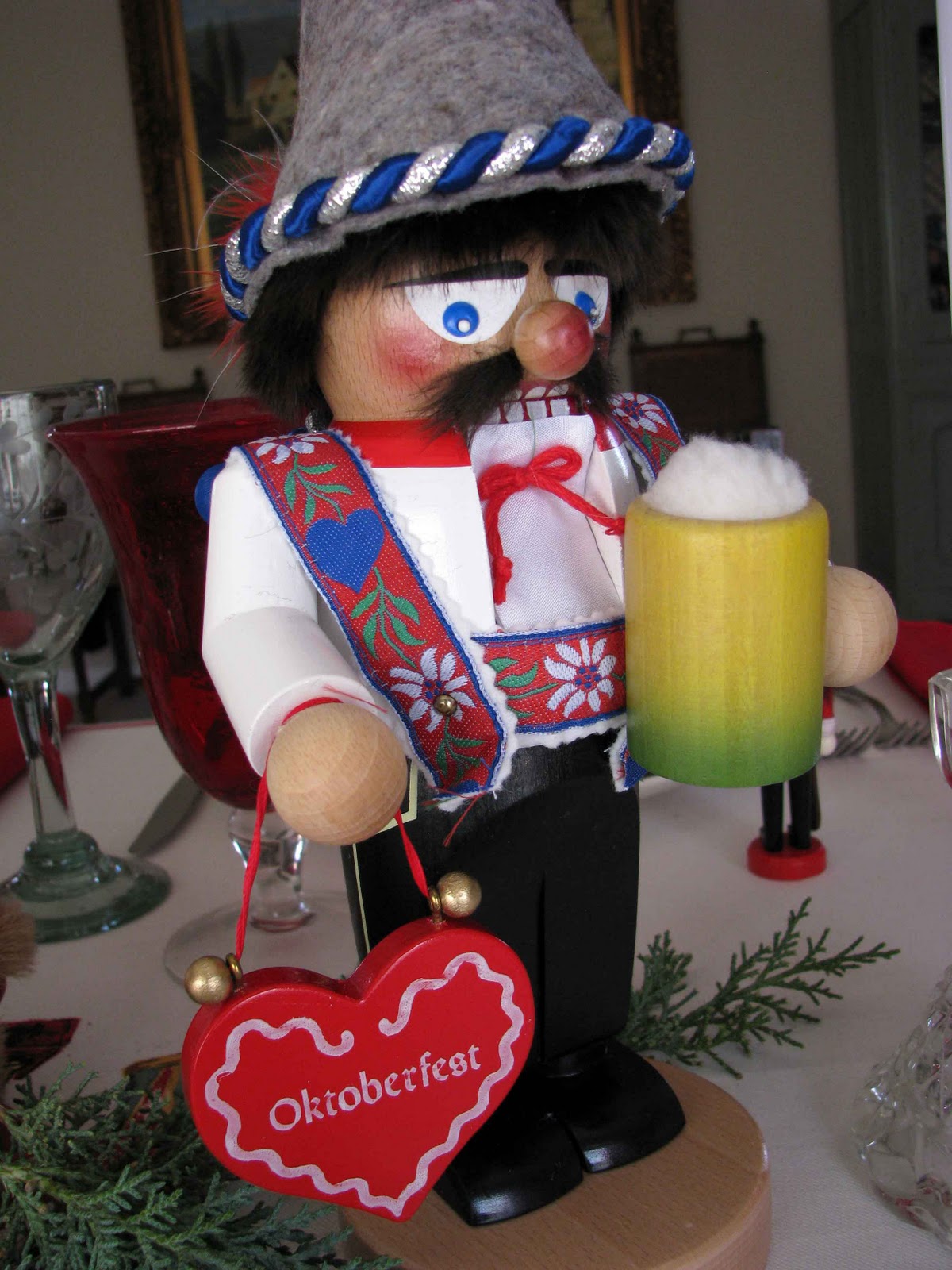
Collected some of his Nutcrackers, most of which are Steinbach's with an occasional imposter thrown in.

How many times have we seen lovely vintage candleholders at Bill's Affordable Accoutrements? Well you know, when I saw these at an estate sale, they just jumped in my arms..


Love the plaid plates behind the red rope edge of the Nutcracker plates. The plaid dishes are Nikko and available at Dillards. They have this sweet little holly/berry ring around the inside perimeter.


These sweeties were found at Michael's for 1 dollar each! Great as a take home give. I will be attaching some place cards to them also.
 This sweetie was found at an estate sale. He's really old.


 Handblown wine hocks from Mexico via Santa Fe, NM. The red bubble glasses were purchased at Stein Mart. last year.

Such a darling place setting.. don't you think? And certainly not "girly"!


Cast:
Tablcloth - Zina Vasi, Dillards
Napkins - from my mother
Dinner plates - Nikko, Dillards
Salad Plates - Williams Sonoma, last year
Flatware - Gorham
Wine hocks - Handblown in Mexico, purchased in Santa Fe, NM
Red water goblets - Stein Mart last year
Candleholders - estate sale
Nutcrackers - from my son's collection
Juniper - from the driveway

I'll be joining Susan's party at Between Naps on the Porch.
I hope to see you there!

Tuesday, December 6, 2011

Happy St. Nikolaus Day - coal or candy which did you get?

St. Nikolaus wood carving from Germany

The true story of Santa Claus begins with Nicholas, who was born during the third century in the village of Patara. At the time the area was Greek and is now on the southern coast of Turkey. His wealthy parents, who raised him to be a devout Christian, died in an epidemic while Nicholas was still young. Obeying Jesus' words to "sell what you own and give the money to the poor," Nicholas used his whole inheritance to assist the needy, the sick, and the suffering. He dedicated his life to serving God and was made Bishop of Myra while still a young man. Bishop Nicholas became known throughout the land for his generosity to the those in need, his love for children, and his concern for sailors and ships.
Through the centuries many stories and legends have been told of St. Nicholas' life and deeds. These accounts help us understand his extraordinary character and why he is so beloved and revered as protector and helper of those in need.


One story tells of a poor man with three daughters. In those days a young woman's father had to offer prospective husbands something of value—a dowry. The larger the dowry, the better the chance that a young woman would find a good husband. Without a dowry, a woman was unlikely to marry. This poor man's daughters, without dowries, were therefore destined to be sold into slavery. Mysteriously, on three different occasions, a bag of gold appeared in their home-providing the needed dowries. The bags of gold, tossed through an open window, are said to have landed in stockings or shoes left before the fire to dry. This led to the custom of children hanging stockings or putting out shoes, eagerly awaiting gifts from Saint Nicholas. Sometimes the story is told with gold balls instead of bags of gold. That is why three gold balls, sometimes represented as oranges, are one of the symbols for St. Nicholas. And so St. Nicholas is a gift-giver.
One of the oldest stories showing St. Nicholas as a protector of children takes place long after his death. The townspeople of Myra were celebrating the good saint on the eve of his feast day when a band of Arab pirates from Crete came into the district. They stole treasures from the Church of Saint Nicholas to take away as booty. As they were leaving town, they snatched a young boy, Basilios, to make into a slave. The emir, or ruler, selected Basilios to be his personal cupbearer, as not knowing the language, Basilios would not understand what the king said to those around him. So, for the next year Basilios waited on the king, bringing his wine in a beautiful golden cup. For Basilios' parents, devastated at the loss of their only child, the year passed slowly, filled with grief. As the next St. Nicholas' feast day approached, Basilios' mother would not join in the festivity, as it was now a day of tragedy. However, she was persuaded to have a simple observance at home—with quiet prayers for Basilios' safekeeping. Meanwhile, as Basilios was fulfilling his tasks serving the emir, he was suddenly whisked up and away. St. Nicholas appeared to the terrified boy, blessed him, and set him down at his home back in Myra. Imagine the joy and wonderment when Basilios amazingly appeared before his parents, still holding the king's golden cup. This is the first story told of St. Nicholas protecting children—which became his primary role in the West.

Another story tells of three theological students, traveling on their way to study in Athens. A wicked innkeeper robbed and murdered them, hiding their remains in a large pickling tub. It so happened that Bishop Nicholas, traveling along the same route, stopped at this very inn. In the night he dreamed of the crime, got up, and summoned the innkeeper. As Nicholas prayed earnestly to God the three boys were restored to life and wholeness. In France the story is told of three small children, wandering in their play until lost, lured, and captured by an evil butcher. St. Nicholas appears and appeals to God to return them to life and to their families. And so St. Nicholas is the patron and protector of children.


Several stories tell of Nicholas and the sea. When he was young, Nicholas sought the holy by making a pilgrimage to the Holy Land. There as he walked where Jesus walked, he sought to more deeply experience Jesus' life, passion, and resurrection. Returning by sea, a mighty storm threatened to wreck the ship. Nicholas calmly prayed. The terrified sailors were amazed when the wind and waves suddenly calmed, sparing them all. And so St. Nicholas is the patron of sailors and voyagers.
Other stories tell of Nicholas saving his people from famine, sparing the lives of those innocently accused, and much more. He did many kind and generous deeds in secret, expecting nothing in return. Within a century of his death he was celebrated as a saint. Today he is venerated in the East as wonder, or miracle worker and in the West as patron of a great variety of persons-children, mariners, bankers, pawn-brokers, scholars, orphans, laborers, travelers, merchants, judges, paupers, marriageable maidens, students, children, sailors, victims of judicial mistakes, captives, perfumers, even thieves and murderers! He is known as the friend and protector of all in trouble or need (see list).


Sailors, claiming St. Nicholas as patron, carried stories of his favor and protection far and wide. St. Nicholas chapels were built in many seaports. As his popularity spread during the Middle Ages, he became the patron saint of Apulia (Italy), Sicily, Greece, and Lorraine (France), and many cities in Germany, Austria, Switzerland, Italy, Russia, Belgium, and the Netherlands (See list). Following his baptism in Constantinople, Vladimir I of Russia brought St. Nicholas' stories and devotion to St. Nicholas to his homeland where Nicholas became the most beloved saint. Nicholas was so widely revered that more than 2,000 churches were named for him, including three hundred in Belgium, thirty-four in Rome, twenty-three in the Netherlands and more than four hundred in England.


Nicholas' tomb in Myra became a popular place of pilgrimage. Because of the many wars and attacks in the region, some Christians were concerned that access to the tomb might become difficult. For both the religious and commercial advantages of a major pilgrimage site, the Italian cities of Venice and Bari vied to get the Nicholas relics. In the spring of 1087, sailors from Bari succeeded in spiriting away the bones, bringing them to Bari, a seaport on the southeast coast of Italy. An impressive church was built over St. Nicholas' crypt and many faithful journeyed to honor the saint who had rescued children, prisoners, sailors, famine victims, and many others through his compassion, generosity, and the countless miracles attributed to his intercession. The Nicholas shrine in Bari was one of medieval Europe's great pilgrimage centers and Nicholas became known as "Saint in Bari." To this day pilgrims and tourists visit Bari's great Basilica di San Nicola.
Through the centuries St. Nicholas has continued to be venerated by Catholics and Orthodox and honored by Protestants. By his example of generosity to those in need, especially children, St. Nicholas continues to be a model for the compassionate life.


Widely celebrated in Europe, St. Nicholas' feast day, December 6th, kept alive the stories of his goodness and generosity. In Germany and Poland, boys dressed as bishops begged alms for the poor—and sometimes for themselves! In the Netherlands and Belgium, St. Nicholas arrived on a steamship from Spain to ride a white horse on his gift-giving rounds. December 6th is still the main day for gift giving and merrymaking in much of Europe. For example, in the Netherlands St. Nicholas is celebrated on the 5th, the eve of the day, by sharing candies (thrown in the door), chocolate initial letters, small gifts, and riddles. Dutch children leave carrots and hay in their shoes for the saint's horse, hoping St. Nicholas will exchange them for small gifts. Simple gift-giving in early Advent helps preserve a Christmas Day focus on the Christ Child.

information from: http://www.stnicholascenter.org/pages/who-is-st-nicholas/

Thank you for droppin in! I love your visit and comments and read every one. Be sure to check out other December posts for fun facts about Christmas!

Monday, December 5, 2011

Advent Calendars

Open the door each day for a new surprise
  • The origin of the Advent Calendar can be traced back to the 19th. Century. The first styles came from the protestant area of Germany. Religious families made a chalk line for every day in December until Christmas Eve. 
The surprises on this calendar are magnetic and stick to the metal picture
  •  The first known Advent Calendar which was made by handwork is from the year 1851.
  •  Other early styles were the Adventclock or the Adventcandle - a candle for each of the 24 days until Christmas, like todays Advent wreath. In religious families, little pictures were hang up on the wall - one for each day in December. An other tradition was to paint chalk strokes on the door, one per day until Christmas Eve.

  • In 1902 a Christian Bookshop in Hamburg published a Christmas Clock which was very similar to that published 1922 by the St. Johannis printing company. (Dominik Wunderlin, lic.phil. Swizzerland). The Austrian (NÖ) Landesmuseum is giving the year 1903 as the year of the first printed Advent Calendar. In 1904 an Advent Calendar was inserted in the newspaper "Neues Tagblatt Stuttgart" as a gift for their readers.
Purchased at the Shop in Santa Fe, NM (they ship), this calendar is battery operated and plays a tune!

  •  In contrast to the above Esther Gajek says that the first printed specimen was made in 1908 by a Swabian parishioner, Gerhard Lang (born 1881 in Maulbronn, Germany -died in 1974).
  • When he was a child his mother made him an Advent Calendar with 24 "Wibbele" (little candies) which were stuck on cardboard.
    pinterest


  • Later Lang was a contributor in the printing office Reichhold & Lang. He produced little colored pictures which could be affixed on cardboard at every day in December.
pinterest

Horchow.com
  • This was the first printed Advent Calendar, although without windows to open, published in 1908. This Calendar was named "Christmas-Calendar" or "Munich Christmas-Calendar". At the beginning of the 20's, Lang produced the first Advent Calendars with little doors that opened.
  • At this time as well the Sankt Johannis Printing Company started producing religious Advent Calendars, with Bible Verses instead of pictures behind the doors.
  • The Advent Calendar  traveled a triumphal way around the globe. But Lang had to close his company in the thirties. Until that time he had produced about 30 different designs. The World War II terminated the success of this German tradition. Cardboard was rationed and it was forbidden to produce calendars with pictures. The first printed calendars after the war were printed by Richard Sellmer in 1946.
    pinterest


    • We know that Advent Calendars filled with Chocolate was already available in 1958.
    pinterest


    I have an addiction to these lovely things called Advent Calendars. I guess that I've had one since I was a tot has something to do with this addiction. I posted some of our collection HERE . An. then there is a closeup of one I made HERE and HERE. I've shared a few pictures from the creative folks on Pinterest and a couple from Horchows.. Enjoy. I hope you will check out the posts from December 1st on.. Thanks for dropping in and I am hoping you are having a wonderful Chris✝mas season!
    pinterest

    pinterest

    pinterest

    pinterest

    pinterest
    horchow.com


Sunday, December 4, 2011

December 4, St. Barbara Day


Die Heilige Barbara
The Legend and the Custom

The patron saint of miners, artillerymen and firemen, die Heilige Barbara (St. Barbara, d. 306), has lent her name to an interesting Germanic Christmas custom that surely has its roots (literally) in pre-Christian pagan times. But the legend of her martyrdom seems to have originated around the 7th century. Officially, she is one of the 14 Auxiliary Saints or Holy Helpers.

The feast day of Saint Barbara is December 4th, and it is this date that plays a key role in the interesting custom that bears the name of this virgin martyr. According to legend, Barbara lived in Asia Minor in what is today Turkey. Her father was the pagan emperor Dioscorus, a suspicious, untrusting fellow who persecuted Christians and kept his daughter a virgin by locking her up in a tower whenever he was away.
One day upon returning home, Dioscorus noticed that the tower where he kept his daughter under lock and key now had three windows instead of two. Puzzled, he asked her why she had added a window in his absence. Barbara then made the mistake of confessing that she had become a Christian, and the three windows represented the trinity of her new faith. Incensed, her father demanded that she renounce this heresy. After some time had passed and she still stubbornly refused to deny her new religion, her father commanded that she be tortured and beheaded. The legend further says that immediately following this gruesome event, Dioscorus was struck dead by lightning (which may explain why St. Barbara is often invoked during thunderstorms).
Another important element of the Barbara-Legende concerns her imprisonment, and led (so they say) to the Christmas custom that bears her name. Depressed and alone in her cell, Barbara found a dried up cherry tree branch which she moistened daily with a few drops from her drinking water. She was greatly consoled by the beautiful cherry blossoms that appeared just days before her impending execution.
 

The Barbara Branch Custom

Traditionally in the German-speaking countries, particularly in Austria and the Catholic regions of Germany, a small cherry branch is cut off and placed in water on December 4th, Barbaratag (St. Barbara’s Day). Sometimes a twig from some other flowering plant or tree may be used: apple, forsythia, plum, lilac, or similar blossoms. But it is the cherry tree that is most customary and authentic.
The cherry branch (Kirschzweig) or other cutting is then placed in water and kept in a warm room. If all goes well, on Christmas day the twig will display blossoms. If it blooms precisely on December 25th, this is regarded as a particularly good sign for the future.

There isn't a cherry tree around from which I can even "borrow" a branch! But as said, many times a substitute branch is used. Hope you enjoyed learning a bit about this Germanic holiday custom! Thanks for dropping in. I've been posting holiday customs since December first and plan to continue a daily post each day until Christmas, come back often if you can!


Saturday, December 3, 2011

The Legend of the Chris✞mas Tree

Oh Chris✞mas Tree

One of my most favorite Christmas memories is being at my German gramdmother's for the Chris✞mas holiday. It was most magical! The afternoon of Chris✞mas Eve, we were not allowed into the living room. It had to be empty of children with the door closed so that when the Christkind came through, there was nothing to disturb the decorating of the tree and the leaving of presents.  
We had to wait until we heard the tinkle of a little bell that the Christkind would ring when the task was finished.To walk into the living room after hearing the little bell was as if you were walking into into a dream come true. The candles would be lit on the tree (o yes.. they did that on Chris✞mas Eve), fresh cookies under the tree, and beautifully wrapped presents!
Das Christkind

The origin of the Christmas tree is obscured by uncertainties of oral histories of pre-literate European cultures. For example, according to Christian lore, the Christmas tree is associated with St Boniface and the German town of Geismar. Sometime in St Boniface's lifetime (c. 672-754) he cut down the tree of Thor in order to disprove the legitimacy of the Norse gods to the local German tribe. St. Boniface saw a fir tree growing in the roots of the old oak. Taking this as a sign of the Christian faith, he said "...let Christ be at the center of your households..." using the fir tree as a symbol of Christianity.

The tradition of the Christmas tree as it is today known is fairly young. It was established by Martin Luther as a Protestant counterpart to the Catholic Nativity scene. Luther established the Christmas tree as a symbol of the Tree of Life in the Garden of Eden.

The custom of erecting a Christmas Tree can be historically traced to 15th century Livonia (present-day Estonia and Latvia) and 16th century Northern Germany. According to the first documented uses of a Christmas tree in Estonia, in 1441, 1442, and 1514 the Brotherhood of the Blackheads erected a tree for the holidays in their brotherhood house in Reval (now Tallinn). At the last night of the celebrations leading up to the holidays, the tree was taken to the Town Hall Square where the members of the brotherhood danced around it. In 1584, the pastor and chronicler Balthasar Russow wrote of an established tradition of setting up a decorated spruce at the market square where the young men “went with a flock of maidens and women, first sang and danced there and then set the tree aflame”. In that period, the guilds started erecting Christmas trees in front of their guildhalls: Ingeborg Weber-Kellermann (Marburg professor of European ethnology) found a Bremen guild chronicle of 1570 which reports how a small tree was decorated with "apples, nuts, dates, pretzels and paper flowers" and erected in the guild-house, for the benefit of the guild members' children, who collected the dainties on Christmas Day.


O Tannenbaum
TEXT: Ernst Anschütz, 1824
MELODIE: Volksweise (traditional)

O Tannenbaum, o Tannenbaum,
wie treu sind deine Blätter!
Du grünst nicht nur
  zur Sommerzeit,
Nein auch im Winter, wenn es schneit.
O Tannenbaum, o Tannenbaum,
wie treu sind deine Blätter!

O Tannenbaum, o Tannenbaum!
Du kannst mir sehr gefallen!
Wie oft hat nicht zur Weihnachtszeit
Ein Baum von dir mich hoch erfreut!
O Tannenbaum, o Tannenbaum!
Du kannst mir sehr gefallen!

O Tannenbaum, o Tannenbaum!
Dein Kleid will mich
  was lehren:
Die Hoffnung und Beständigkeit
Gibt Trost und Kraft
  zu jeder Zeit.
O Tannenbaum, o Tannenbaum!
Das soll dein Kleid
  mich lehren. 


 A Tannenbaum is a fir tree (die Tanne) or Christmas tree (der Weihnachtsbaum). Although most Christmas trees today are Fichten (spruce) rather than Tannen, the qualities of the evergreen have inspired musicians to write several “Tannenbaum” songs in German over the years. The best known version (above) was penned in 1824 by a Leipzig organist named Ernst Anschütz. The melody is an old folk tune. The first known “Tannenbaum” song lyrics date back to 1550. A similar 1615 song by Melchior Franck (1573-1639) goes: “Ach Tannebaum, ach Tannebaum, du bist ein edler Zweig! Du grünest uns den Winter, die lieben Sommerzeit.” - The English version above is a literal translation by your Guide, not the traditional English lyrics for the song. There are at least a dozen English versions of this carol.

Friday, December 2, 2011

Père Noël and Chris✞mas in France

Joyeux Noel; from a c. 1910 postcard.

I lived in Orléans, France for almost 13 years, until I was14. Growing up  in France with their traditions, mingled with those of my German mother and American father who has a traditional Ukrainian background we observed many different holiday traditions. Today, I'll share Chris✞mas in la belle France!

In France, Chris✞mas is a time for family and for generosity, marked by family reunions, gifts and candy for children, gifts for the poor, Midnight Mass, and le Réveillon.

The celebration of Chris✞mas in France varies by region. Most provinces celebrate Chris✞mas on the 25th of December, which is a bank holiday. However, in eastern and northern France, the Chris✞mas season begins on 6 December, la fête de Saint Nicolas, and in some provinces la fête des Rois* is one the most important holidays of the Chris✞mas season. In Lyon, 8 December is la Fête de lumières, when Lyonnais pay hommage to the virgin Mary by putting candles in their windows to light up the city.

*Epiphany (la fête des Rois) is usually celebrated the 6th of January, but in some places in France it is celebrated the first Sunday after January 1st.
 

French Chris✞mas Traditions

French children put their shoes in front of the fireplace, in the hopes that Père Noël (aka Papa Noël) will fill them with gifts. Candy, fruit, nuts, and small toys will also be hung on the tree overnight. In some regions there's also Père Fouettard who gives out spankings to bad children (sort of the equivalent of Santa Claus giving coal to the naughty).

In 1962, a law was passed decreeing that all letters written to Santa would responded to with a postcard. When a class writes a letter, each student gets a response.
 

Le Réveillon

Although fewer and fewer French attend la Messe de Minuit on Chris✞mas Eve, it is still an important part of Christmas for many families. It is followed by a huge feast, called le Réveillon (from the verb réveiller, to wake up or to revive). Le Réveillon is a symbolic awakening to the meaning of Christ's birth and is the culinary high point of the season, which may be enjoyed at home or in a restaurant or café that is open all night. Each region in France has its own traditional Chris✞mas menu, with dishes like goose, chicken, capon, turkey stuffed with chestnuts, oysters, and boudin blanc (similar to white pudding).
 

French Chris✞mas Desserts

Throughout the French Christmas season, there are special traditional desserts:
  • La bûche de Noël (Yule log) - A log-shaped cake made of chocolate and chestnuts. Representative of the special wood log burned from Chris✞mas Eve to New Year's Day in the Périgord, which is a holdover from a pagan Gaul celebration.
     
  • Le pain calendeau (in southern France) - Chris✞mas loaf, part of which is traditionally given to a poor person.
     
  • Treize desserts (in Provence) - nothing like going a little overboard during the holidays.
     
  • La Galette des Rois (on Epiphany) - round cake which is cut into pieces and distributed by a child, known as le petit roi or l'enfant soleil, hiding under the table. Whoever finds la fève - the charm hidden inside - is King or Queen and can choose a partner.


French Chris✞mas Decorations

The sapin de Noël (tree)is the main decoration in homes, streets, shops, offices, and factories. The sapin de Noël appeared in Alsace in the 14th century, decorated with apples, paper flowers, and ribbons, and was introduced in France in 1837.

Another important aspect of French Chris✞mas celebrations is the crèche filled with santons, which is displayed in churches and many homes. Living crèches in the form of plays and puppet shows based on the Nativity are commonly performed to teach the important ideas of Christianity and the Chris✞mas celebration.

Mistletoe is hung above the door during the Chris✞mas season to bring good fortune throughout the year.

After Réveillon, it's customary to leave a candle burning in case the Virgin Mary passes by. (http://french.about.com/cs/culture/a/christmas.htm)


Leaving you with two Chris✞mas songs that I remember from my youth:
Petit Papa Noel
Petit Papa Noël
1. C'est la belle nuit de Noël
La neige étend son manteau blanc
Et les yeux levés vers le ciel
À genoux, les petits enfants
Avant de fermer les paupières
Font une dernière prière.

Petit Papa Noël
Quand tu descendras du ciel
Avec tes jouets par milliers
N'oublie pas mon petit soulier

2. Mais avant de partir,
Il faudra bien te couvrir
Dehors, tu vas avoir si froid
C'est un peu à cause de moi.

Il me tarde tant que le jour se lève
Pour voir si tu m'as apporté
Tous les beaux joujoux
Que je vois en rêve
Et que je t'ai commandés

3. Le marchand de sable est passé
Les enfants vont faire dodo
Et tu vas pouvoir commencer
Avec ta hotte sur le dos
Au son des cloches des églises
Ta distribution de surprises

4. Et quand tu seras sur ton beau nuage
Viens d'abord sur notre maison
Je n'ai pas été tous les jours très sage
Mais j'en t'en demande le pardon

Little Father Christmas

It's a beautiful Christmas night
Snow spreads its white coat
And eyes lift toward the sky
On their knees, small children
Before closing their eyelids
Say one last request
Little Father Christmas
When you come down from the sky
With toys by the thousands
Don't forget my little shoe
But before leaving
You must cover yourself well
Outside you will be so cold
It's a little because of me
I can't wait for it to get light
To see if you have brought me
All the lovely toys that I see in dreams
And that I ordered from you
Little Father Christmas
When you come down from the sky
With toys by the thousands
Don't forget my little shoe
And when you are on your beautiful cloud
Come first to our house
I wasn't always very well behaved
But I ask for your forgiveness
Little Father Christmas
When you come down from the sky
With toys by the thousands
Don't forget my little shoe
Little Father Christmas


Il est ne le petit enfant
Il est né le divin enfant is a traditional French Chris✞mas carol. The tune is not, as far as I know, the same as any song in English, so here is the melody.

Note that my translation is literal, so it doesn't necessarily match the rhythm.


Il est né le divin enfant,
Jouez hautbois, résonnez musette.
Il est né le divin enfant,
Chantons tous son avènement.
Depuis plus de quatre mille ans
Nous le promettaient les prophètes,
Depuis plus de quatre mille ans
Nous attendions cet heureux temps.
Une étable est son logement,
Un peu de paille est sa couchette,
Une étable est son logement,
Pour un dieu quel abaissement.
O Jésus, ô roi tout puissant,
Tout petit enfant que vous êtes,
O Jésus, ô roi tout puissant,
Régnez sur nous entièrement.

          He is born the divine child,
          Play oboe, resonate musette.
          He is born the divine child,
          Let's all sing his accession.
          For more than four thousand years
          We've promised by the prophets,
          For more than four thousand years
          We've been waiting for this happy time.
          A stable is his lodging,
          A bit of hay is his little bed,
          A stable is his lodging,
          For a god such a humble thing.
          O Jesus, o all powerful king,
          Such a little child you are,
          O Jesus, o all powerful god,
          Rule completely over us.

Je vous souhaite un Joyeux Nöel et bonne année!

Thursday, December 1, 2011

A Tinsel Tree - December 1

Source: Martha Stewart website

Tinsel Tree

In both Ukrainian and German lore, the tale of the Chris✞mas spider explains the origin of tinsel. The story tells of a poor widow who couldn't buy fancy gifts for her children or decorations for their tree. One Chris✞mas Eve, she decorated a tree as best she could with fruits and nuts. After she went to sleep, spiders came out and crawled over the tree, leaving their webs behind. When Father Chris✞mas  visited the house, he saw the web-covered tree and decided to turn the webs to silver. In the morning when the family awoke, the tree was sparkling and beautiful.


It's December first.. This year I'll be bringing you little daily tidbits of Chris✞mas lore and stories. I hope you stay tuned! Thanks for dropping by..

LinkWithin

Blog Widget by LinkWithin